Renewing Faith and Fraternity in 2026

I did not write a New Year post when the calendar turned. Not because the moment lacked meaning, but because our life as Warrior Penitents is not governed by dates as much as it is by fidelity.

Still, the beginning of a year invites reflection on our faith and on our journey. Not on resolutions that fade, but on who we are walking with and why we walk at all along a path less traveled.

As we step into this year, the Community of Warrior Penitents is called to renew its focus, not by adding burdens, but by returning to what is essential: Christ, fraternity, prayer, and service lived faithfully together.

We Do Not Walk Alone

One of the deepest wounds many veterans carry is isolation, whether by force or by choice. After years of shared mission and mutual reliance, civilian life can feel fragmented and solitary. Our community exists precisely to answer that wound. We are not recreating the military, rather we are forming something deeper: Christian fraternity between brothers and sisters in arms and faith.

We are not a collection of individuals pursuing holiness on parallel paths. We are brothers and sisters bound by a shared Rule of Life, walking toward Christ side by side, developing depths of strength in our bonds between one another.

This year, let us be intentional about presence:

  • Check in on one another.
  • Pray for one another by name, immediately when in need.
  • Show up, even when it is inconvenient. Be the brother or sister who can be counted on regardless of the day or time.
  • Refuse the quiet drift toward isolation. Seek fraternity and community among one another.

Fraternity is not an accessory to our faith. It is one of the ways Christ chooses to sustain us.

Focus Before Force

The temptation at the start of any year is to do more, through resolutions to pray more, read more, serve more. While discipline matters, focus matters more. Maybe it is time to strengthen something that is already part of your life to grow stronger in your faith.

Our Rule of Life already gives us direction:

  • A life rooted in prayer.
  • Faith expressed through works of mercy and charity.
  • Simplicity, humility, and readiness to serve.

Rather than adding new demands, let this year be about greater faithfulness to what we have already embraced. A well-prayed Divine Office. Scripture read attentively and meditated upon. Service offered without recognition, the only witness being those served and our Lord. Small acts done consistently out of charity and love.

Holiness is not achieved through intensity alone, but through perseverance and consistency, and a willing to get up and begin again after falling.

Active Contemplation, Lived Together

Active contemplation is prayer united to action and is not meant to be lived in isolation. Our prayer shapes our service, and our service deepens our prayer. When we share that rhythm as a community, it becomes a source of strength.

This year, let us allow our common prayer and common mission to bind us more closely. Let our prayer build bridges between one another. Let our service sharpen our love for the poor and those in need. Let accountability be an expression of care, not control.

In a divided world, a community that prays, serves, and remains united becomes a powerful witness and does more than demonstrate our faith, it shares it with the hearts of others.

Faith That Endures

This year will bring challenges, some expected and others not. Fatigue, doubt, and distraction will test each and every one of us. But endurance is something we understand well.

As Warrior Penitents, we are not called to perfection, and we knowingly will never attain it on this side of Heaven. We are called to faithfulness and action. To return again and again to Christ. To rise when we fall. To remain when leaving would be easier. To help our brother and sisters in arms to carry their burden, together.

Let this be a year marked not by grand achievements, but by quiet perseverance.

A Simple Intention for the Year

If we were to name a single intention for the year ahead, let it be this:

To grow closer to Christ by growing closer to one another.

Grow in your prayer life.
Grow in fraternity, within your community.
Grow in service with a willingness to serve anyone in need.

May we be men and women who carry one another’s burdens, who seek Christ in the poor, and who remain rooted in the humility and simplicity of St. Francis.

We walk forward together, we are all penitents, brothers and sisters, servants of Christ.

May God bless you this year and may you finish 2026 stronger in your faith and relationships.

In Christ and Prayer,

WP

Growing in Faith: A Call to Action for 2026

As one year closes and another approaches, many people begin to set goals; physical goals, financial goals, professional goals. Yet for Christians, and especially for those of us formed by discipline, sacrifice, and service, the most important question is not what will I accomplish? but who will I become?

As we look toward 2026, the Community of Warrior Penitents invites all Catholics, especially our brothers and sisters who have served or who are currently serving, to dedicate the coming year to growing intentionally in the Catholic faith and living that faith openly through service to our neighbors.

This is not a call to shouting louder words, but to a clearer witness.

Faith That Is Lived, Not Hidden

Catholic faith was never meant to be confined to the private sphere. From the earliest days of the Church, Christians were recognized not primarily by what they said, but by how they lived; how they loved, how they forgave, how they cared for the poor, the sick, the needy, and the forgotten.

Our Lord Himself is unmistakably clear:

“By this all will know that you are My disciples, if you have love for one another” (John 13:35).

To live an open life of faith does not mean seeking attention or approval. It means refusing to separate belief from action, prayer from service, or Sunday worship from weekday living. Faith that remains hidden quickly becomes faith that withers.

Formation Before Action

The temptation is always to rush into doing. But the Church teaches, and experience confirms, that right action flows from right formation.

Dedicating 2026 to the Catholic faith begins with returning to the sources:

  • Sacred Scripture, read daily and prayed with reverence
  • The Sacraments, especially the Eucharist and Reconciliation
  • The Liturgy of the Hours, uniting our days to the prayer of the Church
  • The Rosary, contemplating Christ through the eyes of Our Lady
  • The teachings of the Church, received humbly and lived faithfully

For Warrior Penitents, this discipline is familiar. Just as training precedes mission, spiritual formation precedes fruitful service.

Faith Made Visible Through Service

The Letter of St. James leaves no room for ambiguity:

“Faith by itself, if it has no works, is dead” (James 2:17).

An open life of faith is one that naturally moves outward. Love of God finds expression in love of neighbor. Prayer bears fruit in mercy and charity

In 2026, we are called to make our faith visible through:

  • Commitment to the Corporal and Spiritual Works of Mercy
  • Intentional service within our local communities
  • Presence to those who are lonely, struggling, in need, or forgotten
  • Willingness to give time, attention, and dignity, not just financial resources where they are needed

This is not about heroic gestures. It is about consistent fidelity in ordinary places: families, neighborhoods, parishes, workplaces.

Veterans Living With Purpose

For many veterans, the loss of mission after service leaves a deep ache. The Catholic faith offers not a replacement mission, but a greater one—a lifelong vocation rooted in Christ.

The discipline, readiness, and sense of brotherhood formed in military service find new direction when ordered toward the Gospel. In the Community of Warrior Penitents, fraternity becomes accountability, and accountability becomes love expressed through action.

To dedicate 2026 to faith lived openly is to reclaim purpose, not for personal fulfillment alone, but for the good of others and the glory of God. A purpose of self-growth and community growth towards Christ.

A Public Witness, Quietly Lived

Living an open life of faith does not require confrontation, argument, or spectacle. Often, it is the quiet consistency of a life shaped by Christ that speaks most powerfully. It is the bridges built in charity that bring the most people to the Church and to Christ.

  • Choosing integrity when compromise would be easier
  • Serving when no one is watching
  • Praying before acting (and praying while acting)
  • Forgiving when resentment feels justified

In a world hungry for authenticity, a Catholic life lived with humility, simplicity, and love becomes a powerful sign of hope.

A Resolution Worth Making

As 2026 approaches, consider making a resolution not simply to believe more, but to live more fully what you believe.

Let this be a year marked by:

  • Deeper prayer
  • Stronger community
  • Concrete service
  • Visible charity
  • Faith that moves from the heart, through the hands, to the community

For the Community of Warrior Penitents, and for all who walk alongside us, may 2026 be a year of growth, witness, and renewal. A year where faith is not hidden, but offered freely in service to Christ present in our neighbors.

May we live what we profess.
May we serve whom we love.
May we follow Christ, openly and faithfully.

May the Saints and Apostles pray for your growth this next year, and may there be opportunities for you to live charitably through faith in Jesus Christ.

In Christ and Prayer,

WP

“Dilexi Te” – Opening Our Hearts to the Poor This Advent

As we draw near to the birth of our Lord Jesus Christ, the Church once again invites us to return to the heart of the Gospel: love. Not an abstract or sentimental love, but a love that stoops low, enters suffering, and takes flesh among the poor.

In his Apostolic Exhortation Dilexi Te (“I have loved you”), the Holy Father Leo XIV reminds all Christians that love for the poor is not an optional devotion or secondary concern; it is a direct response to the love with which Christ has first loved us. To love Christ is to love those with whom He chose to identify: the poor, the forgotten, the wounded, and the marginalized.

For us as the Community of Warrior Penitents, this call resonates deeply with our Rule of Life and our lived experience as veterans.

Christ Chose Poverty

The mystery of Christmas is not merely that God became man, but that God became poor.

Jesus was born not in a palace, but in a stable. He was laid not in fine linens, but in a manger. From His first breath, Christ aligned Himself with those who have little, those who depend entirely on the mercy of others.

In Dilexi Te, the Holy Father emphasizes that this was no accident of history. It was a deliberate revelation of God’s heart. Christ reveals that true strength is found in humility, and true glory is found in self-gift.

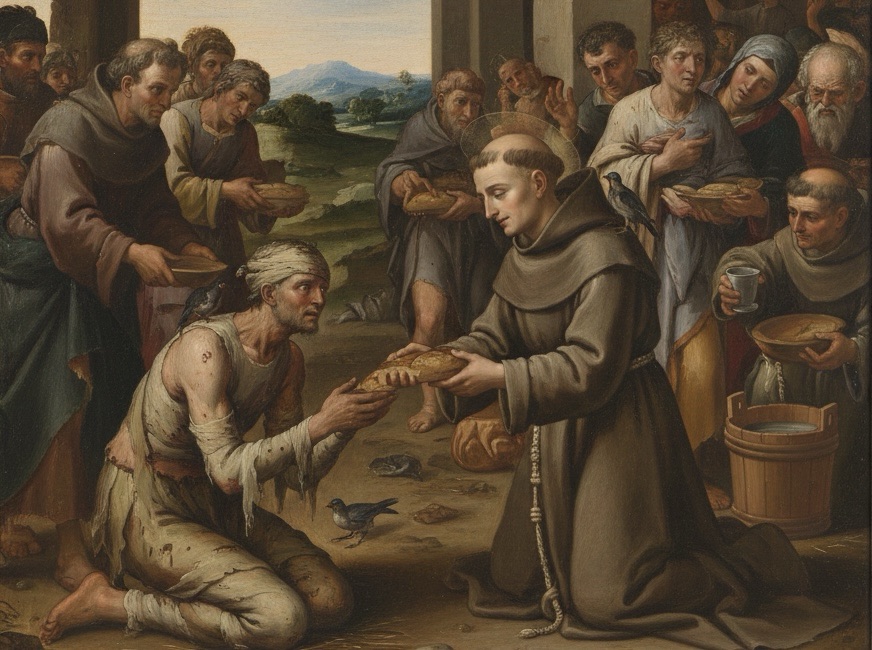
This truth echoes the life of St. Francis of Assisi, a soldier turned penitent, who recognized Christ most clearly in the poor and chose to live among them, not as a benefactor above them, but as a brother beside them.

Veterans and the Poor: A Shared Wound

Many veterans understand, perhaps more than most, what it means to be unseen, misunderstood, or forgotten. The transition from military life to civilian life often brings a loss of structure, identity, and community. In this sense, many veterans encounter a form of poverty. Whether that experiential poverty is material, relational, or spiritual, it is still experienced to the core of the veteran.

The Holy Father reminds us that the poor are not only those without money. Poverty includes loneliness, despair, addiction, displacement, and loss of meaning.

As Warrior Penitents, our own wounds become places of encounter. Having known hardship, we are uniquely positioned to recognize Christ in those who struggle. Our Rule of Life calls us not to retreat inward, but to allow our healing to become mission.

Active Contemplation: Love Made Visible

At the heart of our community is active contemplation, the union of prayer and action, where love for God flows naturally into love for neighbor.

Dilexi Te reinforces this truth: prayer that does not lead to mercy is incomplete, and service that is not rooted in prayer risks becoming empty activism. Christ calls us to both.

As Advent invites us into watchful waiting, we are challenged to ask:

Do our prayers open our hearts, or harden them?

Do we recognize Christ in the poor, or only in the sanctuary?

Are we willing to be inconvenienced by love?

To love the poor is not merely to give alms, but to give ourselves, our time, our presence, our attention, and our dignity.

Preparing a Place for Christ

As we prepare our homes, our liturgies, and our hearts for Christmas, the Holy Father urges us to remember that there is no room for Christ where there is no room for the poor.

The manger still stands before us as a question:

Will we make space?

For the Community of Warrior Penitents, this means recommitting ourselves to the Corporal and Spiritual Works of Mercy: feeding the hungry, clothing the naked, visiting the sick, comforting the sorrowful, and walking patiently with those who suffer.

It means living simply, giving generously, and loving concretely.

“I Have Loved You”

Dilexi Te is not first a command, it is a reminder.

“I have loved you.”

From that love flows everything else.

As we approach the birth of Jesus, may we allow His love to reorder our priorities, soften our hearts, and sharpen our readiness to serve. May we recognize Him not only in the manger, but in the faces of the poor He continues to love through us.

Come, Lord Jesus.

May You find room among us

In Christ and Prayer,

WP

Overcoming Sin: Putting God Before Self

At its core, sin is the choice to love ourselves before God. It is the disordered preference of our will over His, our desires over His commandments, and our comfort over His call to holiness. Every sin, no matter how small, flows from this root—a turning inward rather than upward.

But the beauty of our faith is that we are not trapped in sin. Through prayer, fasting, and trust in God, we can reorient our hearts, turning away from self-love and toward divine love.

The Root of Sin: Self-Love Before God

From the very beginning, sin has been the result of choosing self over God. Adam and Eve disobeyed because they wanted to “be like God” (Gen 3:5). The Tower of Babel was built in an attempt to make a name for themselves (Gen 11:4). Even the rich young man, who kept all the commandments, walked away from Jesus because he loved his possessions more than the call to follow Christ (Matt 19:21-22).

St. Augustine described sin as “love of self to the point of contempt for God.” It is not just doing bad things; it is choosing ourselves over Him—whether through pride, greed, lust, or even complacency in our faith. We are tickling the senses rather than worshipping the One who created us.

Yet, despite our failures, God calls us back. He is always ready to forgive, restore, and transform us if we are willing to put Him first.

The Path to Renewal: Prayer, Fasting, and Trust

If sin is self-love before God, then the antidote is placing God before the self. The Church gives us three powerful tools to help us do this:

1. Prayer: Seeking God First

Prayer is the act of turning our hearts back to God. When we neglect prayer, we begin to rely on our own strength, making ourselves the center of our lives. But when we pray, we acknowledge that God is greater than us, that we need Him, and that our purpose is found in Him alone.

Jesus Himself gives us the model of prayer in the Our Father:

“Our Father, who art in heaven, hallowed be thy name. Thy kingdom come, thy will be done.” (Matt 6:9-10)

Regarding the frequency of prayer, St. Paul tells us that we are to “Pray without ceasing.” (1 Thess 5:17)

Prayer is not about asking for what we want but about aligning our will with His. It is an act of humility—putting God first in our hearts and minds.

2. Fasting: Denying Self for Love of God

Fasting is one of the most powerful ways to reorder our loves. It forces us to confront our dependence on comfort, pleasure, and self-will.

When we fast, we say:

“Lord, I deny myself because I love You more than my desires. I hunger for You more than for food. I thirst for Your righteousness more than for comfort.”

The Desert Fathers understood this well. St. John Cassian wrote:

“Fasting is the guardian of the soul. It gives wings to our prayers.”

Fasting weakens our attachment to self, making room for God’s strength in our weakness (2 Cor 12:9).

3. Trust: Letting God Provide

Sin often stems from a lack of trust in God—believing that we must take control because He will not provide. This is the great lie that led Adam and Eve to grasp for the fruit rather than trust in God’s goodness.

But Jesus calls us to radical trust:

“Seek first the kingdom of God and His righteousness, and all these things will be added unto you.” (Matt 6:33)

When we let go of self-reliance and place our trust in God, we no longer need to grasp for security, power, or control. Instead, we can rest in His providence, knowing that He is enough.

A Call to Repentance and Renewal

If we truly desire to overcome sin, we must ask ourselves:

• Do I put God before myself in all things?

• Do I pray without ceasing, seeking His will rather than my own?

• Do I fast, disciplining my desires so that God can increase in me?

• Do I trust Him completely, or do I rely on myself?

Sin does not have to define us. God’s mercy is greater than our failures. Through prayer, fasting, and trust, we can reorder our lives, placing God where He belongs—at the center of everything.

Lent is approaching. Let us begin today by choosing God over self, dying to sin, and living in the freedom of His love.

“Whoever loses his life for my sake will find it.” (Matt 16:25)

In Christ and Prayer,

WP

Plunging Our Lives into Eternity: Living with Daily Purpose in Light of What Comes After

“We lose sight of Jesus and eternity and get lost in the ordinary daily realities.”

— Sr. Theresa Aletheia Noble, FSP

In the heart of Lent, we are reminded not only of Christ’s Passion but also of our own mortality. For many, this is sobering. For the Christian, it is an invitation—an invitation to step out of the fog of distraction and into the clarity of eternity, to live with the awareness that this life is not the end, but the beginning.

Reading ‘Remember Your Death’, the powerful Lenten devotional by Sr. Theresa Aletheia Noble, FSP, I was struck by her challenge to plunge our lives into the context of eternal life. What would change if we truly lived each day with heaven in view? How would our relationships, choices, and habits be transformed if we understood that every moment echoes into eternity?

Losing Sight of Eternity in the Everyday

We’re all susceptible to it—being overwhelmed by the mundane, the ordinary, the noise. Sr. Theresa writes that we lose sight of Jesus and eternity when we get lost in the daily routine. Whether it’s the grind of work, the exhaustion of parenting, the burdens of trauma, or the distractions of our digital age, we forget who we are and where we are headed.

But Jesus doesn’t call us to escape the ordinary—He calls us to redeem it. He meets us in the mess and invites us to live every moment as a response to His eternal love.

Living a Life That Reverberates Into Eternity

This means that no moment is meaningless. When we root our day in prayer, when we unite our daily tasks with Christ, we live lives that echo into eternity.

The Saints understood this well:

• St. Thérèse of Lisieux showed us that even the smallest acts, done with love, can shake the gates of heaven.

• Brother Lawrence prayed while he worked in the kitchen, teaching us to “practice the presence of God” in all things.

• St. Francis of Assisi lived with simplicity, poverty, and joy—showing that holiness isn’t found in isolation but in the ordinary embraced with extraordinary love.

Woven Prayer, Ordinary Holiness

What might it look like to truly live a prayerful life in a world that demands your constant attention?

It doesn’t always require more hours—it requires more intention.

• Begin the day with a simple morning offering.

• Carry Scripture with you—even just a verse—and recall it often.

• Invite God into your routine: thank Him for your meals, your work, the people you meet.

• Close the day in quiet reflection. Ask: “Did my life today echo into eternity?”

Prayer is not an escape. It is a reorientation.

A Call to Veterans: You Were Made for More

If you’re a veteran, you know what it means to live for a mission. You’ve experienced the strength of brotherhood, the value of discipline, and the deep need for purpose. That mission doesn’t end when the uniform comes off.

The Community of Warrior Penitents is a place where veterans live a new kind of mission—one rooted in Christ. Through a Rule of Life, daily prayer, fasting, acts of mercy, and fraternity, we live intentionally and sacramentally, supporting one another on the road to heaven.

If you’re looking for more—if you want to order your life around eternity, to build true community, and to grow in your Catholic faith—we invite you to reach out. You are not alone in this battle. There is a place for you.

“Set your minds on things that are above, not on things that are on earth. For you have died, and your life is hidden with Christ in God.”

— Colossians 3:2–3

In Christ and Prayer,

WP